Teen Lawn Care - Learn How Kids and Teenagers Can Make Money with a Yard Business
Home | Get Updates Via RSS | Get Updates Via Email | Why Get Updates? | Profile | Rescources | Advertise
Business | Services | Equipment | Spring/Summer | Fall | Winter | Product Reviews | Question and Answer | Inspiration | Rescources | Unlabeled

Blogs I Like

JuniorBiz - Young people, grownup business!
Blog written by Nick Tart about young business

The Lawn Blog
Blog written by Richard Murphy all about lawn care and lawn business

Kelly's Lawn Care Blog
Blog written by Kelly Burke about lawn care

Life and Lawns - Lawn Care Tips Blog
Blog written by Allyn Paul that discusses lawn care

Recharge Mower - Electric Riding Lawn Mower
Today I received an email from someone with Driven By Solar Inc. about the Recharge Mower. They asked if I would like to post a press release for their product, and I agreed.

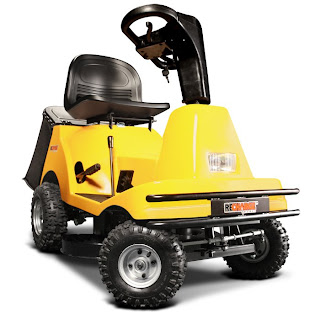
The Recharge Mower is a battery-powered lawn mower that looks a bit like a yellow Mars rover. Sexy, anyone?

Anyhow, enough of my ramblings. Let's see what Recharge Mower has to say about their product:
A greener lawn. A greener planet. That’s what the revolutionary new riding Recharge Mower™ is all about. With up to 3 hours of continuous operating power between charges, you can beautify your property while doing your part to protect the environment.

Unlike a majority of push and riding mowers, the Recharge Mower™ uses NO GAS- NO OIL – NO SPARK PLUGS – NO TUNE UPS and operates Extremely Quietly. That means you can care for your lawn without adding to Air or Noise Pollution.

According to the U.S. Environmental Protection Agency (EPA), a traditional gas powered lawn mower produces as much air pollution as 43 new cars each being driven 12,000 miles. The EPA states that 17 million gallons of fuel, mostly gasoline, are spilled each year while refueling lawn equipment. That's more than all the oil spilled by the Exxon Valdez. In addition to groundwater contamination, spilled fuel that evaporates into the air and the volatile organic compounds spit out by small engines, make smog-forming ozone when cooked by heat and sunlight. Also, according to the Noise Pollution Clearinghouse (NPC), the 85 to 90 decibels of noise produced by a typical gas-powered mower can be heard a quarter mile away or more. In other words, mowing a quarter-acre lot with a gas-powered mower pollutes 100 acres of the surrounding neighborhood with noise.

Over 3 years of engineering, design, and development combine in the release of the Recharge Mower™. The unit features a proprietary electronically controlled 36v38Ah power system. This system can be fully reenergized overnight by simply plugging in the included Smart Charger into a standard wall outlet. For an average cost of only 55 cents, the Recharge Mower™ will be fully repowered and ready to provide dependable service.

The Recharge Mower™ features a 27-inch wide cutting deck and has 5 selectable cutting heights for precision lawn care. Unlike other riding mowers, the Recharge Mower™ has been specifically designed to pass through standard fence gates for convenient access to front and rear yards. Even the included rear mounted grass catcher is easily emptied and installed without tools or special skills. This ideal width combines with smooth, nimble handling to make maneuvering around trees and shrubs effortless.

The resilient moulded body is fitted over a coated and welded metal frame providing long dependable life. The three sealed batteries are positioned both low and center, improving balance and weight distribution. The Twin long life and powerful 900 watt cutting blades are housed within the metal shrouded deck. Additionally, the powerful rear wheel drive electric motor provides abundant forward and reverse momentum. The entire system is operated through uncomplicated hand controls which are easily accessible from the driver’s seat. Ultimately, this makes the Recharge Mower™ perfect for both physically fit and mobility challenged adults.

Having undergone exhaustive testing, the Recharge Mower™ meets or exceeds UL1447 and ANSI B71.1 safety standards. Safe operation of any machine is paramount and the Recharge Mower™ includes many safety features including a Operator presence switch, blade activation safety control, an audible reverse warning indicator and many more.

The Recharge Mower™ is covered by a 2 Year Limited Residential Use Warranty.

For more details, a collection of custom accessories and to watch the full length video,
to go the website:
www.RechargeMower.com
or contact Dealer/Media Relations at:
1.647.884.3300
Pretty cool stuff. Here's a 20 point list of the features of the Recharge Mower to summarize the press release:

1. Up to three hours of continuous operating power between charges

2. Uses no gas, no oil, no spark plugs, and needs no tune-ups

3. Operates extremely quietly

4. Zero air/noise pollution

5. The unit features a proprietary electronically controlled 36v38Ah power system

6. The electricity used to power the Recharge Mower costs an average of 55 cents a charge

7. Has a 27-inch wide cutting deck

8. 5 selectable cutting heights

9. Has been specifically designed to pass through standard fence gates

10. The rear mounted grass catcher is easily emptied and installed without tools or special skills

11. Easy handling

12. Resilient moulded body, fitted over a coated and welded metal frame

13. The three sealed batteries are positioned both low and center, which is good for balance and weight distribution

14. The 900 watt cutting blades are housed within the metal shrouded deck

15. Rear-wheel drive

16. Has good forward and reverse momentum

17. Operated through uncomplicated hand controls, which are easily accessible from the driver's seat.

18. Meets or exceeds UL1447 and ANSI B71.1 safety standards

19. Safety features include an Operator presence switch, a blade activation safety control, an audible reverse warning indicator, among others

20. This product is covered by a 2 Year Limited Residential Use Warranty.

I haven't ever actually used the product. I don't know a whole lot about riding lawn mowers, either. So I'm not even going to TRY recommending it to you.

However, I still think this mower could be an interesting option if you want to buy a battery-powered riding lawn mower.

If you are interested in this kind of equipment, just make sure you do your homework and check out all the options available.

Keep the Recharge Mower in mind, though.

Labels: ,


If you enjoyed this post, recieve notification of the latest posts via RSS or via email:

I will never rent, sell, or share your email address


How to Buy a Used Lawn Mower

Guest article written by Steve from Lawn Mower Guide

If you are starting a lawn care business and need to do it "on the cheap" then you definitely should look at getting a used lawn mower. Mowers nowadays are built with quality in mind, so with proper maintenance you can use your used mower for many years to come.

Don't Be Too Picky


At the onset of your mower search you may have a certain brand in mind. Don't fall into the trap that you are looking for a specific brand and never end up buying anything because you couldn't find the perfect deal.

There are more lawn mower manufacturers out there than you may realize, but many use the same engine. Briggs and Stratton as well as Honda engines are considered to be the best in the field. Personally, I own an MTD mower with a Honda engine and have never had a problem starting it.

You will find that the used lawn mower market is a first come first serve because in truth, many people do not sell their mowers. The market in my city is very lean, but perhaps in a more major market you may find that you will have better luck.

Check Auctions


I have been to a couple police auctions and you wouldn't believe what the police are selling for a fraction of their retail price! Contact your local police agency and see if they are holding an auction in your area. Police like to do spring cleaning so in April/May you will have a better shot of attending one.

Police auctions are not the only auctions in your area. Use Google Maps or even your yellow pages and search for auctions in your area. I guarantee there will be more than you expected. Not all auctions contain lawn mowers so call ahead of time and find out.

Online Sources


The two places I would recommend searching for a lawn mower online would be Kijiji and Craigslist. I say this because both of these classified ad sites are locals selling to locals. The problems that can arise from buying off of a site such as Ebay is that someone from across the country could turn what looks to be an amazing deal into a horrible one by charging horrendous shipping and handling. Stick with Kijiji and Craigslist and you can drive to the person's house and pick up your mower in a matter of hours.

Classifieds


Last but not least check the classifieds in your local paper. Some people still don't use the internet or haven't learned of free online classifieds. The benefit here is that most people have forgotten about paper classified ads and stick to searching online only. If you are lucky you could find a great deal and you will have barely any competition.

Steve's website, Lawn Mower Guide does lawn mower reviews. If you find a mower you would like to buy. Check out Steve's site for a review of the product!

Labels:


If you enjoyed this post, recieve notification of the latest posts via RSS or via email:

I will never rent, sell, or share your email address


Essential Tools for Lawn Care

Lawn Care Tools

Photo by Dan4th

Photo by dvs

Photo by *sean

Photo by Vasto

Photo by fotogail
There are many tools associated with running a lawn care business. These include mowers and weed eaters, as well as rakes and leaf blowers. In this post I will outline all the tools needed to take care of a lawn year round.

Mower

A mower is necessary for cutting grass in the spring and summer. There are three kinds of mowers: gas, electric, and reel. Most people use gas mowers, and it is what is generally expected. However, you could offer electric or reel mowing as a special service.

Gas and electric mowers can have extra features, such as bagging or mulching. Bagging is when the blade shoots the grass into a bag attached to the back of the mower. Mulching is when the blade chops up the grass into the smaller pieces than regular cutting would. Mulching is helpful for mowers that spray the grass out to the side, because it reduces clumping and allows the nutrients in the cut grass to return to the ground.

Mowers also come in different sizes, which I discuss in this post.

Weed Eater

A weed eater is needed for almost all lawns to cut the grass in places the mower can't get to. A weed eater can also be used to edge the grass, although edgers, which I will discuss later, give a cleaner cut. There are two types of weed eaters: gas and electric. Electric weed eaters need to be plugged in, so if you use an electric one, make sure your customers have outdoor electrical outlets. Learn more about gas and electric weed eaters here.

Edger

I do not have much experience with edgers, seeing as my buddy just edges with his weed eater. However, Kelly Burke does. According to her website:
A power edger is like a string trimmer except with metal blades and a vertical cutting head, while a hand edger uses a stepping motion and a sharp half circle cutting edge. Edgers create dramatic cut lines where the lawn meets walkways and beds. Not an essential piece of equipment but some warm-season grasses tend to creep into adjacent areas if not frequently edged.
If you have the level of business and the money to invest, an edger could really improve the look of your customers' lawns. However, until then, I would stick with the weed eater.

Lawn Aerator

A lawn aerator is necessary for keeping grass healthy. It is basically a long metal tube that has a hole-making device at the end. This device is pushed into the lawn all over, making holes in the ground. The holes aerate the yard. My dad used to do this to our yard, but then it became too much of a pain and he stopped doing it. Our grass is still fine. However, I'm sure you could make some extra cash by offering it as a service to your customers.

Push-Type Spreader

Push-type spreaders are used to spread things like grass seeds and fertilizers on a lawn. Grass should be planted every other year or so, depending on the lawn. I've never tried doing this for my customers, but again, you could probably get some money for it.

Leaf Rake

Leaf rakes are useful tools for leaf removal from yards in the fall. I have found that a large plastic rake can be more efficient than a small electric blower. However, leaf rakes aren't just limited to leaves, but can be used to sweep up almost any other type of debris.

There are different types of rakes for different types of jobs. I prefer a large, plastic one for sweeping leaves off of a lawn. However, smaller, metal leaf rakes can be used effectively for getting leaves off the top of and from underneath bushes.

Blower

Blowers are useful for moving things like leaves and grass clippings. Small, electric weed eaters are usually more trouble than they're worth, but if you have an opportunity to obtain a gas backpack blower, get it. Although I've never used one myself, from what I've seen they make the job a good deal easier. When it comes to getting grass clippings off the sidewalk, I've found that running your lawn mower over the sidewalk to blow the clippings into the yard works pretty well.

Learn more about lawn care during the fall season here.

Wheel Barrow

When mulching a person's yard, a wheel barrow is a necessity. First, fill it with mulch using a shovel or a pitchfork. Then, push it to the place you want to cover with mulch. After that, lean the barrow over until all of the mulch is out. Then, it's time for the bow rake.

Bow Rake

A bow rake is the other necessary tool for mulching a customer's lawn. After you have placed the mulch in the place you want to spread it, push the mulch back and forth with the bow rake in the areas you want to be covered.

Conclusion

When performing lawn care, make sure you are prepared with the tools for the job. Be it mulching, mowing, or leaf raking, always know what you will need to accomplish your task.

Labels:


If you enjoyed this post, recieve notification of the latest posts via RSS or via email:

I will never rent, sell, or share your email address


How to Perform a Lawn Mower Tune-Up

It is necessary to perform a lawn mower tune-up every season. This lengthens the life of your mower and makes it run better. Your mower will be getting a good deal of wear and tear because hopefully, it will be well-used every season.

Before you start

Before beginning a lawn mower tune-up, you should let the engine run a bit. After this task is complete, detach the spark plug wire to prevent the engine from starting unintentionally. After you have done these two things, you are ready to begin your tune-up.

Change the oil

The first task is to change the oil. The first step is to make sure the oil you are going to replace the old oil with is the correct type for your unit. Then, wipe off the dirt on the upper section of the oil tank. An old toothbrush works well for this job. Next, you will need to raise up your mower with two blocks. After your mower is raised so that you can work underneath it, find the plug on the bottom of the oil tank. Then, place a container to catch the old oil underneath and unscrew the plug. After the oil is drained, screw the plug back on. Check if your mower has an oil filter. If it does, replace it and clean the gasket, which is what the filter is touching. After this, put your mower back on the ground and pour the new oil in the tank. Next, run your mower and check for leaks, and this task is done.

Sharpen the blade

(update 5/6/09)

Sharpening the blade on your mower is an important part of your tune up. Doing this will keep your mower running as efficiently as possible, and is also better for the grass. First, remove the blade and bring it to your work bench. I like eHow's description on how to sharpen your blade:

Sharpen the blade by moving the file toward the cutting edge with smooth, even strokes. Follow the original bevel of the blade as closely as you can. Make the same number of strokes on each edge. If you take more metal off one side than the other, the blade will be out of balance. An out-of-balance blade cuts unevenly; it also makes the mower vibrate, which can cause serious damage to the engine.

The last thing you should do is to make sure the blade is balanced. You can do this by placing the blade on the end of the screw driver. If one side sticks up, you will need to sharpen that side a bit more. When you blade is all sharpened, refasten it to your mower, and this task is completed.

Spark plug and air filter

The first thing you want to do is to clean the housing around the spark plug. Then, make sure the gap for the spark plug is the right size using a feeler gauge. You are done with the spark plug. (Make sure not to put it back on yet!) If your mower has a paper air filter, replace it. If it has a foam air filter, wash it thoroughly. You are done with the air filter. Now, all you have to do is reconnect the spark plug, and you are finished tuning up your lawn mower.

Tuning up your lawn mower is an essential task every season. It will save you a lot of mower trouble in the future. Good luck cutting grass for cash!

Further Reading:
http://landscaping.about.com/od/toppicks/a/mower_tuneup.htm

Labels: ,


If you enjoyed this post, recieve notification of the latest posts via RSS or via email:

I will never rent, sell, or share your email address


26 Tips for Weed Eater Safety

Weed eater safety is a serious problem. The U.S. Consumer Product Safety Commission estimated that in 1989, about 4,600 injuries were treated by emergency departments as a result of weed eater use. One third of these injuries were eye injuries.

Hopefully you won't get hurt as a result of running your teen lawn service. However, the following 26 tips can help you to keep your body intact.

Weed Eating Safety Tips


1. Wear thick boots while weed eating to protect your feet.

2. Wear eye and ear protection. (Remember those ONE THIRD being eye injuries?)

3. Read the operating manual for your weed eater.

4. Wear long pants to protect your legs.

5. Before beginning to cut vegetation, clear the trimming area stones, sticks, wire, and other debris prior to weed eating.

6. Use a fire-safe muffler in dry conditions.

7. Wear relatively tight-fitting clothing and tie back your long hair-- loose clothing and long hair can get caught in the moving parts of a weed eater.

8. Cut the engine and disconnect the spark plug wire when making repairs and modifications to the weed eater.

9. Wear shoes with good traction so you don't slip and lose control of your weed eater.

10. Wear work gloves while using/working on the weed eater to protect your hands.

11. Make sure to use the correct fuel mixture if the weed eater is gas powered.

12. Wait until the engine is cooled down before putting gas in the weed eater.

13. Stop the weed eater abruptly if someone comes within 30 to 60 feet of you because weed eaters can fling debris violently, up to 30 feet.

14. Be sure your weed eater does not have loose belts or ineffective guards.

15. Periodically check your weed eater for damage or wear.

16. Permit the weed eater's engine to return to idle speed when you are not actually trimming.

17. Keep the weed eater's cutting part beneath waist height.

18. Only allow the blade to rotate as fast as it needs to in order to cut your objective vegetation.

19. Start the engine on firm ground in an open place, holding the weed eater with two hands while having good balance and footing.

20. After use, secure the weed eater in order to avoid gas spillage and or damage when moving the unit.

21. Don't allow grass and other debris to pile up on the weed eater because this accumulation is a fire hazard.

22. After use, make sure the trimmer tool is shielded with the carrying guard.

23. Also after use, allow the engine to idle down for a few minutes so it can cool off.

24. Stop the engine prior to setting the weed eater down.

25. Don't wear headphones if you are weed eating near a road.

26. Don't try to do any mechanical work on the weed eater when it is running.

Like I said in my lawn mowing safety post, just use common sense. Don't do anything dangerous that could hurt you or anybody else. Well then, good luck on running a safe and successful teen lawn care!

Further Reading:
http://www.hoosieruplands.org/NurseArticles/LAWNSAFE.pdf
http://www.securityworld.com/ia-418-weed-trimmers-can-throw-objects-and-injure-eyes.aspx
http://tiny.cc/diusl

Labels: ,


If you enjoyed this post, recieve notification of the latest posts via RSS or via email:

I will never rent, sell, or share your email address


Do's and Don'ts for Lawn Mowing Safety

Lawn mowers are extremely dangerous to use and operate. A mower's blade can throw debris at a speed of 200 miles per hour, and gasoline has the explosive force of 33 sticks of dynamite. Emergency departments have to treat about 68,000 people with injuries from power lawn mowers every year, more than 9,000 of which are teens under the age of 18. According to the American Academy of Pediatrics, injuries from lawn mowing include "deep cuts, loss of fingers and toes, broken and dislocated bones, burns, and eye and other injuries." From the same source, "Older children and adolescents were most often hurt while cutting lawns as chores or as a way to earn money." Well, that certainly relates.

However, all these bad effects can hopefully be prevented by abiding by the following Do's and Don'ts:

DO'S


1. Wear closed-toe shoes, preferably thick boots, to protect your feet while mowing-- most definitely DO NOT mow barefoot or in sandals.

2. Wear close-fitting attire that has little chance of getting caught in the mower's machinery.

3. Wear long pants to protect your legs from objects ejaculating from underneath the mower.

4. Wear ear and eye protection.

5. Wear shoes with good enough traction to help prevent you from slipping. Losing your footing could result in you potentially messing up your body, the mower, and or the lawn you are working on.

6. Read the operating manual for the lawn mower you are using.

7. Make sure that your mower can run over fixed objects around the yard (like sprinkler heads, for example) without the blade hitting them before passing your mower over these things. If it doesn't work out, just mow around the obstacle.

8. Make sure your mower works well and is in good condition before mowing.

9. Shut off your mower if it starts smoking. Smoke means that something is WAY hotter than it is supposed to be or something is burning.

10. Keep all four wheels in contact with the ground, because debris could fly up and hit you. According to a study by the Johns Hopkins Bloomberg School of Public Health, the majority of lawn mowing injuries occur because of debris being throw from underneath the lawn mower. Many people are hurt by this because not only can the person operating the mower get injured, but also bystanders.

11. Stay with your mower when it is running.

12. Position the wheel height BEFORE you start the mower.

13. Stop the mower when you want to clean out the discharge shoot.

14. Always inform someone of where you are while you are mowing, just in case a problem arises.

15. Search for miscellaneous items lying around the yard before you mow, because these objects (toys, etc.) can be broken up and thrown by your mower if you run over them.

16. Before mowing, search for holes which you might step in. Not only could you twist your ankle, you could also lose control of the mower, causing problems.

17. Be sure that children and pets are far, far away from your mower when it is running.

18. Employ a mower with a control that stops itself when the handle is not in use.

19. Start and refuel your mower OUTSIDE.

20. Keep your mower's blade sharp.

DON'TS


1. Never mow down a steep slope because you could easily slip, causing your foot to get wedged between the fast-spinning blade. Either push the mower up the hill or, the best option, push your mower across, although this pattern isn't always possible. If you think a slope too steep to mow safely, ask your client about it.

2. Don't allow grass or other debris to build up on your mower. The blade or the engine have the potential to light those things on fire.

3. Don't mow with a leaking gas tank. It is a fire hazard to you and to the grass.

4. Never have more than one person on a riding mower. If one of you falls off, major injury could very likely occur.

5. Don't leave your mower running when you are crossing pavement. Objects can be flung WAY faster on that kind of surface.

6. Don't touch a hot engine. Although occasionally fun to pop, blisters get annoying after a bit.

7. Don't empty the grass-catching bag while the mower is running. The grass will go all over the place in a disorderly way. However, more importantly, you never want to put your fingers near a moving blade.

8. Don't use your mower for something it was not made for.

9. Don't alter your mower to boost the engine's power or increase the rotation speed of the blade. This will NOT make your job easier, rather, it will only make your job more hazardous.

10. Never eliminate a safety feature from your mower.

11. Never overfill your gas tank. If you do accidentally spill gas, clean it up.

12. Don't put gas in you mower while it is going. Putting gas in a hot mower could just in general start a fire. Don't do it.

13. Don't mow in the dark. Not only is it dangerous, you probably will do a horrendous job anyway.

14. Don't mow on wet grass because you could slip and fall.

15. Don't mow when there is thunder and lightening.

Lawn mowing can be very dangerous, but if you follow the above tips, you will most likely be fine. Above all, use common sense. If something you are doing or thinking about doing seems like it might be dangerous, stop and reflect on how many fingers could be lost as a result of the action. Good luck mowing lawns safely.

Further Reading:
http://www.juniorbiz.com/lawn-mowing/13-lawn-mowing-safety-tips
http://www.aap.org/family/tipplawn.htm
http://health.usnews.com/articles/health/healthday/2008/06/17/health-tip-lawn-mowing-safety.html
http://medicine.tamhsc.edu/health-tips/mowing-safety-3-2007.html
http://msucares.com/pubs/publications/p1097.pdf

Labels: ,


If you enjoyed this post, recieve notification of the latest posts via RSS or via email:

I will never rent, sell, or share your email address


My New Push-Propelled Mower

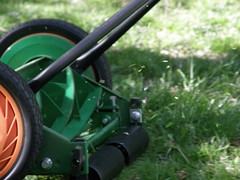
Man mowing lawn Just got a basically free push-propelled mower! Well, my dad may have paid $5 or something for it, but he didn't charge me. It is pretty cool, and I have tried it out on one of my lawns.

One of the things that surprised me about the mower was how much easier a time I had going up hills with it. While with my other relatively light gas mower (no self-propulsion, but I have tried it out and I consider a light gas mower as easy to push up a hill as an almost definitely heavier self-propelled mower, more on that issue here)I have to bend over and put all my weight into pushing it up and down the hill, the reel mower is relatively easy to use going up hills. This is definitely a positive.

Although one might guess that a reel mower is tough to move compared to a gas one, it is actually about the same pushing power needed to maneuver the reel mower on the lawn. So using a reel mower takes just as much energy to push as a gas one.

Another positive is that one can mow any time of day without bothering the neighbors. If you need to do something in the afternoon but can mow in the morning, this can be a definite plus.

However, I had problems with it as well. One of my big issues with it was that I couldn't pull it backwards to get that small section of grass; the mower must be pushed forward every time the grass is cut. Although this may not seem like a big deal, in a lawn with many plants and trees to maneuver around, it gets very annoying.

Another problem I had with it was that since the blade wasn't really sharp, the cut wasn't as clean as it would have been with my gas mower. You basically have to go over the lawn twice if you want a good cut, and this is definitely necessary, seeing as people are paying you to mow their lawn.

But, as we all know, there is one thing that will make us look beyond all the negatives: more money. Although I haven't tried it yet, and probably won't be able to until next season, I am pretty sure that you can charge a heck of a lot more to mow someone's lawn with a reel mower. It's environmentally friendly, and most commercial lawn services probably don't offer it. So instead of making the usual twenty dollars a pop, you might be able to make, oh, fifty dollars a pop. As Borat would say in a Kazakhstani accent, "very nice."

Reel mowers have their pluses and negatives, and can occasionally be preferable to a gas mower, although they can sometimes be a BIG pain in the ass. But, the bottom line is, it can add a fresh element to your business, which can attract more customers and potentially more money. And isn't that the reason we made this business in the first place?

Labels: ,


If you enjoyed this post, recieve notification of the latest posts via RSS or via email:

I will never rent, sell, or share your email address


Should You Use an Electric or Gas Weed Eater?

One of the important things to decide for your teen lawn service is whether you should use an electric or gas weed eater. They both have good points and bad points, and in this post I will discuss these.

Electric or Gas?

Most of the time, I think a gas weed eater will serve you best. They don't need to be connected to a power source and you don't have to mess with an annoying cord. You can just use them. (However, you might disagree with this statement when you have to do some kind of oil gas mix to run the dang thing.)

However, if you are in a situation where there are plenty of power sources and it is easy to do, an electric weed eater can be nice. All you have to do is pull a power button harder or softer to make the weed eater go on and be more powerful. You don't have to start it or leave the engine running. It is much quieter. There are also a lot less expenses associated with electric weed eaters. For example, they tend to cost less and you don't have to spend money on gas and oil.

I think that in most situations, a gas weed eater will be better than an electric one. If you live in a neighborhood where everyone has electric outputs everywhere and you don't want to have to deal with some of the issues that gas ones tend to have, then sure, an electric one might suit you better. It always depends on the situation. Always.

Labels: ,


If you enjoyed this post, recieve notification of the latest posts via RSS or via email:

I will never rent, sell, or share your email address


Big Mower or Small Mower?

Note: This post won't apply to you if you use a riding mower.

When deciding what mower to use for your teen lawn service, some questions come up. Chicken or the egg? The Vikings or Columbus? Big mower or small mower? Although all these questions are important, we will only be focusing on one of them in this post.

Big mower or small mower?

Big mowers that propel themselves may seem like a good idea. All you have to do is steer, right? But consider this: when you are going up a hill with enough grade, the mower may not have the power to push all its weight up. You will have to do a lot more pushing with a big mower because it is so much heavier. Although you have to do all the pushing for a smaller mower, it is lighter, and therefore easier to push. Also, if you are doing a smaller yard, the big mower might be too hefty, whereas a small mower is light and easily maneuverable. Another thing is, how much gas are you willing to buy? The current national average for a gallon of gas is $3.97 (July 2008). That's a good bit, and the big mower will need more gas than a smaller, non-propelled one. Additionally, if you have to push the mower to your neighbor's house, then the big mower could be really annoying. It isn't being propelled when it's not running.

However, big mowers also have their advantages. If your mower is wider, you have the potential to finish a yard faster. Also, if the yard you are cutting is large and flat, with no hills, then you won't have to push the mower up a hill, and using a big one could be less tiresome.

There are pros and cons to each, and I think it really depends on the lawn you are cutting. If you are just starting out, I would try to use a smaller, lighter model, and move on from there. However, if you have been running your business a while, then ask yourself these questions: Which mower will make me use less energy? With which mower will I take less time to mow the lawn? Your answers to those questions will determine which mower you use.

Please share your thoughts in the comments. Big mower or small mower?

Further Reading:
How to Properly Mow a Lawn

Labels: ,


If you enjoyed this post, recieve notification of the latest posts via RSS or via email:

I will never rent, sell, or share your email address


Previous Posts

Get Updates

RSS Get Updates Via RSS

Subscribe to my RSS feed

What is RSS?

Get Updates Via Email
join our mailing list
* indicates required

About Teen Lawn Care

Mow Lawns for Money

Teen Lawn Care is a blog to help you succeed as a teen lawn entrepreneur. I use my firsthand experience to help you make your lawn business the best it can be. <<See first post

Sponsors